Body Doubling: The Focus Technique That Makes Work Feel Easier
You sit down to work. The task is clear. Nothing is stopping you except the strange and frustrating fact that you cannot seem to start. You open the document, close it, open it again. You check your phone. You make coffee you do not need. Forty-five minutes later, you have done nothing.
Now imagine doing that same task while sitting across from a friend who is working on their own thing. Neither of you speaks. There is no collaboration. But within a few minutes, you are both just - working. The task that felt impossible alone suddenly happens.
This is body doubling. And it works for far more people than you might expect.
What Body Doubling Actually Means
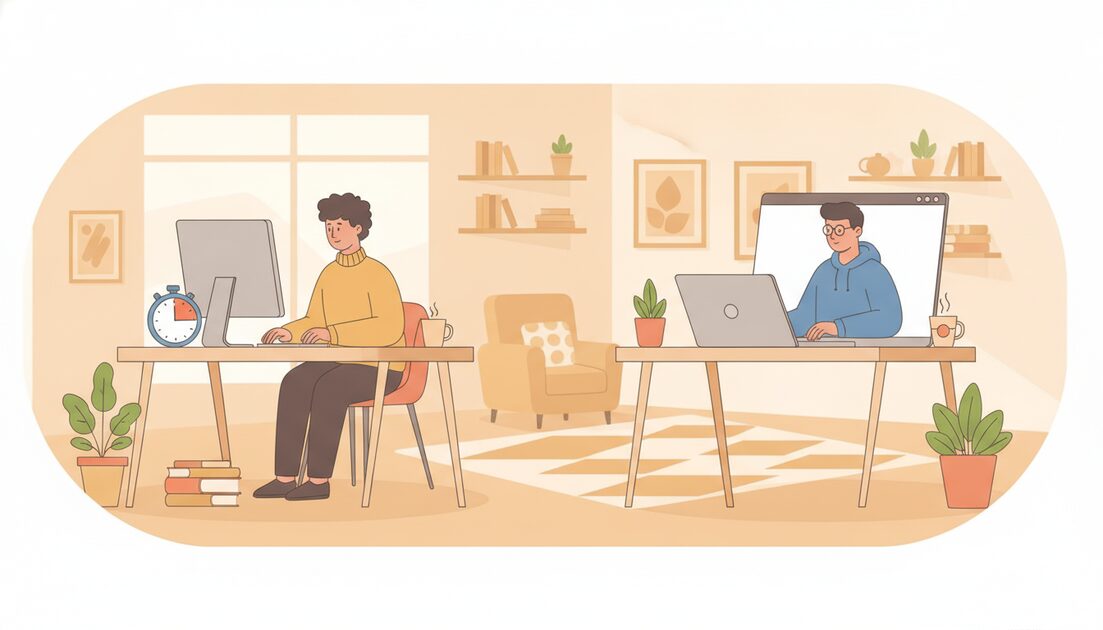
Body doubling is a productivity technique where you work alongside another person to help yourself stay focused. The other person does not need to help with your task, advise you, or even talk to you. They just need to be there. Their presence creates a kind of ambient social awareness that makes it easier to start work and sustain attention on it.
The term comes from ADHD coaching. Therapists and coaches observed that many clients who struggled to work alone could focus much more reliably when another person was physically present - not helping, just existing in the same space. The "double" in body doubling refers to having another body alongside yours as a regulatory anchor.
But you do not need an ADHD diagnosis to benefit from body doubling. Anyone who has ever been more productive in a coffee shop than at home, or who has gotten more done in the office than on a solo work-from-home day, has experienced the effect. The human brain is a social organ. It pays attention differently when it knows other people are watching.
The Psychology Behind It
Several psychological mechanisms explain why another person's presence changes how we work.
Social facilitation
In 1898, psychologist Norman Triplett noticed that cyclists rode faster when racing alongside others than when racing against the clock alone. Subsequent research showed that the mere presence of other people - not competition, just co-presence - affects performance on tasks. This is called social facilitation. For well-learned or relatively simple tasks, observers tend to improve performance. The effect extends to working independently alongside others who are not even watching you.
Accountability without pressure
Body doubling creates a gentle social contract. You told someone you would work for the next hour. That person is sitting across from you (or on your screen). There is a low but real cost to checking your phone every three minutes - you feel it, even if they never say a word. This is softer accountability than a deadline or a manager hovering over you, but it is persistent and surprisingly effective. It is just enough friction to make avoidance less attractive than starting.
Reducing the pain of starting
A lot of procrastination is not about the work itself - it is about the moment of transition from not-working to working. That transition feels costly, especially for tasks that are ambiguous or unpleasant. When another person is present and already working, you are pulled into their rhythm. The transition is shorter because you are already in a context where work is happening. You pick up the social cue and go.
Reduced isolation and rumination
Working alone, especially from home, can turn into a cycle of distraction and self-criticism. You get pulled away, notice you got pulled away, feel bad about it, think about how you should be working, and then get pulled away again. Another person's presence interrupts this loop. There is less room for the mental spiral when you are in a shared context. The social stimulus occupies enough of the background awareness that the rumination has less space to run.
Who Benefits Most
Body doubling tends to help most with three groups of people, though it is useful to anyone who struggles with getting started or staying on task.
People with ADHD
Body doubling was originally developed as an ADHD coaching tool and remains one of the most consistently recommended strategies for adults with ADHD. The executive function challenges associated with ADHD - difficulty initiating tasks, sustaining attention, managing transitions - are directly addressed by the environmental scaffold body doubling provides. Many people with ADHD describe it as one of the few things that actually works, rather than something they have to force themselves to do.
Remote workers
Remote work removes the ambient social structure of an office - the background presence of colleagues, the natural rhythm of the workday, the casual check-ins. For many people, that structure was doing more motivational work than they realized. Body doubling provides a substitute. A virtual co-working session with a colleague or friend recreates the feeling of being in a shared space without requiring anyone to physically commute.
Creative and knowledge workers
Creative work - writing, coding, designing, researching - is especially vulnerable to avoidance because progress is often invisible and the feedback loop is slow. You can spend 25 minutes staring at a blank document and have nothing to show for it. Body doubling does not solve the creative challenge, but it keeps you in the chair long enough for something to actually happen. Many writers report that their most productive sessions come from sitting down in a cafe or library where other people are working, not from finding the perfect inspiration at home.
How to Set Up Body Doubling Sessions
In-person body doubling
The simplest version: find another person, go somewhere, and work. Co-working spaces, libraries, cafes, and even a friend's kitchen table all work. The other person does not need to be working on the same type of task. A writer and a programmer can body double together just as effectively as two writers. All that matters is that both people are engaged in focused work during the session.
If you are going to body double regularly with the same person, set clear expectations upfront: session length, whether you will talk during breaks, and what signals you will use if you need to focus (headphones on, for example, means do not interrupt).
Virtual body doubling
Virtual body doubling is now the more common form, and it works well. A video call with cameras on provides enough social presence for most people. The basic setup:
- Connect with your partner on video (Zoom, Google Meet, FaceTime - anything works)
- State what you each plan to work on for the session
- Mute microphones and work in silence
- Set a timer - 25 to 50 minutes is a good starting point
- When the timer ends, take a short break and check in
The check-in at the end of each session matters more than it might seem. Saying "I finished the first draft of that section" or "I got the tests passing" closes the accountability loop and gives both people a moment to reset before the next block. It turns a passive co-presence into an active commitment structure.
Pairing body doubling with a Pomodoro timer makes the sessions easy to structure. Each Pomodoro becomes a natural work block, and the break at 25 minutes is a natural moment to briefly connect with your partner before the next round.
Services and communities
If you do not have someone to body double with, several platforms match strangers for virtual co-working sessions. Focusmate is the most well-known - you book 25 or 50-minute slots, get matched with a partner, and work on video together. The community is large enough that you can usually find a slot whenever you need one. Study groups, Discord servers, and subreddits focused on productivity and ADHD often have co-working channels or scheduled sessions as well.
Solo alternatives
When no partner is available, some people find partial benefit from solo alternatives that simulate ambient presence:
- Study-with-me videos - YouTube channels that broadcast hours of silent focused work, often in a visually pleasing environment
- Virtual co-working livestreams - real-time streams where the host and chat are all working together
- Public background sounds - coffee shop audio or library ambiance can partially recreate the social context without an actual person
- Working in a public place - a library or cafe, even with strangers, provides more ambient social structure than an empty home office
These alternatives are not as effective as a real partner for most people, but they are far better than struggling alone and they are available any time.
Body Doubling vs Other Focus Techniques
| Method | Core mechanism | Best for |
|---|---|---|
| Body Doubling | Social presence and accountability | Starting tasks, working alone, ADHD |
| Pomodoro Technique | Time-boxing with forced breaks | Structuring focused sessions, managing fatigue |
| Deep Work | Protected blocks of distraction-free time | Cognitively demanding, high-value tasks |
| Flow State | Matching challenge to skill level | Creative work, skill development |
| Monotasking | Single-task focus without switching | Reducing context-switching cost |
| Don't Break the Chain | Streak-based habit consistency | Daily habits, long-term consistency |
Body doubling works well alongside most other focus methods. You can run Pomodoro sessions during a body doubling session - the timer handles the structure, the partner handles the social anchor. You can use body doubling to get started on deep work that you then continue alone once the momentum is going. The techniques are complementary, not competing.
Making It a Consistent Practice
The people who get the most from body doubling tend to build it into a regular schedule rather than using it only when they are desperate. A standing weekly co-working session with a colleague removes the friction of arranging it each time. Booking Focusmate sessions in advance commits you to the block on your calendar. Treating body doubling like any other calendar appointment - rather than a last resort when you are already stuck - means you benefit from it before you need it.
A few practical habits that help:
- State your task at the start. Tell your partner what you are working on before you start. This small act of intention-setting makes the session more focused than sitting down without a plan.
- Use a timer. Having a clear endpoint - whether it is 25 minutes or 90 - makes it easier to fully commit rather than half-working while wondering when the session will end. A Pomodoro timer is the simplest tool for this.
- Keep a focus log. Tracking what you worked on during each session builds a record of your progress and shows you which types of tasks you get done more reliably when body doubling versus alone.
- Protect the session. Treat a body doubling session like a meeting with another person - because it is. Do not cancel because you think you will get around to the work later. The point is to commit to the time.
It is also worth tracking how body doubling affects your energy across the day. Some people find that body doubling in the morning when they are fresh produces the best work. Others use it specifically for tasks they dread, regardless of time of day. Noticing the pattern helps you schedule sessions where they will have the most impact.
Getting Started
The fastest way to experience body doubling is to try it today. Here is the minimal version:
- Find a partner. A colleague, friend, family member, or a stranger on Focusmate. Any willing participant works.
- Set a time. Even 25 minutes is enough to feel the difference. Book it like a real appointment.
- State your task. Tell your partner what you plan to work on before you start. One sentence is enough.
- Set a timer and work. Open your Pomodoro timer, mute your mic if on video, and just go.
- Check in at the end. What did each of you get done? A two-minute debrief closes the loop and builds the habit.
Most people who try body doubling are surprised by how much of a difference it makes on the first session. The productivity increase is not subtle - it is often the difference between a morning where nothing gets done and one where meaningful work actually happens.
If you have been relying entirely on willpower and good intentions to get work done, body doubling offers something different: an environmental change that makes focused work the path of least resistance rather than the one that requires constant effort. You are not fighting your brain's social wiring. You are using it.
Frequently Asked Questions
What is body doubling?
Body doubling is a productivity technique where you work alongside another person - in the same room, on a video call, or even as a recorded presence - to help you stay on task. The other person does not need to help with your work or even speak to you. Their presence alone creates a kind of social accountability that makes it easier to start and sustain focused work. The term originated in ADHD coaching but has since spread to anyone who struggles with motivation, procrastination, or working alone.
Does body doubling work if the other person is on a video call?
Yes. Virtual body doubling is just as effective for most people as in-person. A simple video call where both parties work silently with cameras on is enough to create the social presence effect. Many remote workers use this regularly through services like Focusmate, Discord study rooms, or even just a standing video call with a colleague. The key is that you can see (or feel) the other person's presence while you work.
Why does body doubling help people with ADHD?
People with ADHD often have lower levels of dopamine and norepinephrine, which makes it harder to sustain attention on tasks that are not intrinsically stimulating. Another person's presence adds a mild external stimulus - social awareness - that can activate the brain's attention systems enough to bridge the gap. It also reduces the isolation that often feeds avoidance behavior. Many people with ADHD describe it as "borrowing someone else's focus," though the mechanism is not about energy transfer but about creating the right environmental conditions for attention.
Can I body double alone using a recording or timer?
Some people find success with solo body doubling alternatives like YouTube study-with-me videos, virtual co-working livestreams, or even an AI chat session. These can provide a sense of ambient human presence without requiring another real person. Results vary - some people get a meaningful focus boost from these methods, others need a real live person. If you cannot find a partner, try starting with a focused work timer and a study-with-me video in the background to see if the ambient presence effect helps you.
How long should a body doubling session be?
Most body doubling sessions run 25 to 90 minutes, with 50 minutes being a common sweet spot for virtual sessions. Starting with a Pomodoro-style 25-minute block is a good way to lower the barrier to entry - both you and your partner commit to just 25 minutes of silent work, then take a break to check in. Longer sessions work fine once you are both in the habit, but shorter blocks are easier to commit to and easier to fit into busy schedules.